
Discover how we’re working to protect our local environment from biosecurity threats like Phytophthora Dieback and the Polyphagous shot-hole borer, and learn how you can help safeguard our trees and natural areas.
Polyphagous Shot-Hole Borer
Polyphagous Shot-Hole Borer (PSHB), first detected in WA in August 2021, is an invasive beetle species that infests a wide range of trees, causing damage by boring into the wood and spreading pathogenic fungi.
Allowing this pest to spread in Western Australia could have a significant impact on our urban canopy and may pose a threat to our valuable agricultural industry.
In June 2025, the National Management Group responsible for directing eradication programs for exotic pests and diseases determined that it is no longer technically feasible to eradicate Polyphagous shot-hole borer from Western Australia.
A national Transition to Management plan is now being developed to transition from the eradication response to a management phase.
Department of Primary Industries and Regional Development (DPIRD) will lead the transition to management in WA to minimise the impact of shot-hole borer on Perth’s tree canopy and help protect the State’s horticultural industries.
Over the next 18 months, the department will work with industry, community and local government partners to build capacity to manage the pest.
The Perth metropolitan quarantine area is now split into two zones; the management zone, covering the inner metropolitan area where the borer is already present, and the containment zone on the outskirts of the metropolitan area.
As the City lies within the management quarantine zone landholders are now responsible for pruning and removal of infested trees, supported by DPIRD’s advice and training.
This means the City of Melville community will need to work together to help stop the spread of PSHB.
For more information on PSHB, please click here.
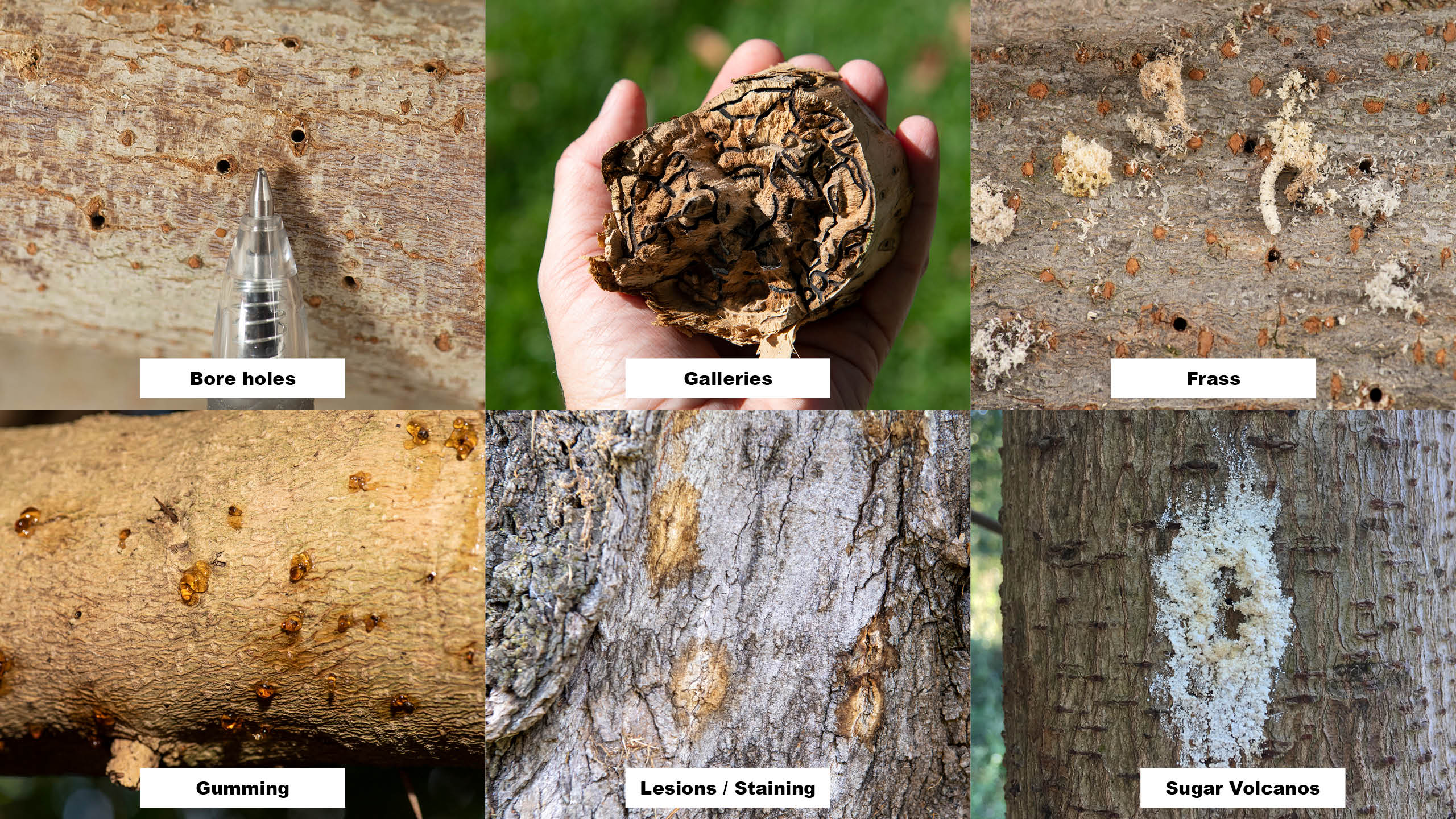
What can I do to help manage PSHB?
Residents should keep an eye out for the signs of PSHB at home or when visiting green spaces across the City and report any suspicious signs immediately.Inspect your trees and plants for any symptoms before and after pruning; if you find any suspicious symptoms of PSHB, leave the plant or the prunings on your property and report these findings to DPIRD immediately.
Symptoms to look for include shot holes that are approximately the size of a sesame seed, galleries (tunnels) and frass (noodles) or crystalline foam (sugar volcanoes) coming from the holes.
If you suspect you have borer damage to trees, make a report to the department through the MyPestGuide™ Reporter app or contact the Pest and Disease Information Service on 9368 3080 or contact them by email.
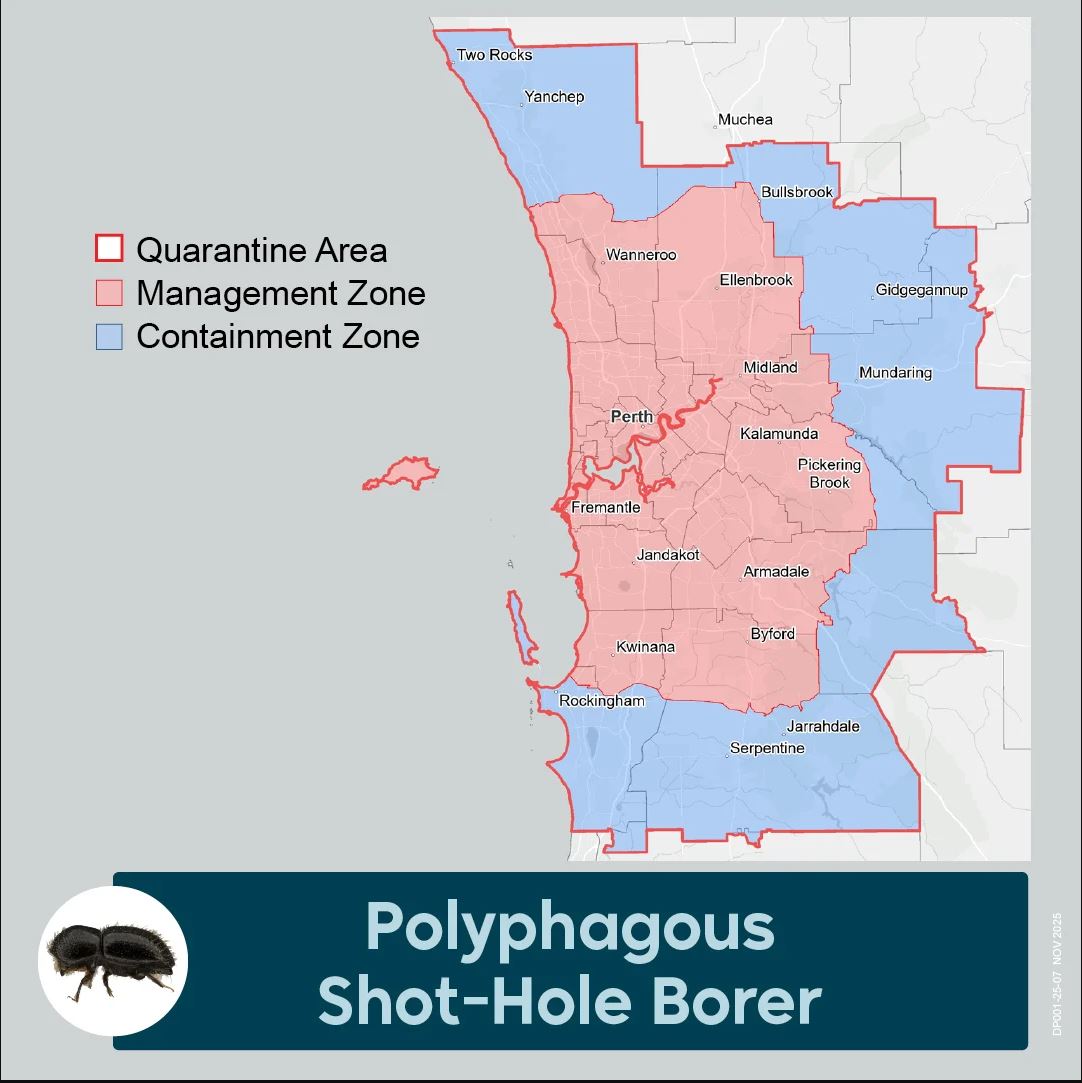
Quarantine Area
A Quarantine Area (QA) covering the entire Perth metropolitan area is in place, with restrictions on the movement of wood, green waste, mulch, live plants and plant material.
The QA is split into two zones:
- The Management Zone which covers the inner metropolitan area and is the area of known borer infestation; and
- The Containment Zone which is the area between the Management Zone and the outer boundary of the QA.
Movement Restrictions
To limit the spread of shot-hole borer, the following restrictions apply to the movement of host plant material:
Host plant material must not be moved from the Management Zone to the Containment Zone or to outside the QA.
Host plant material must not be moved from within the QA to outside the QA.
Any machinery, equipment and vehicles used in the processing or handling of wood, including wood mulching and chipping, must be cleaned of all wood and plant material before being moved into the Containment Zone or outside of the QA.
These restrictions apply to host plant material such as unseasoned wood, green waste and mulch that is larger than 2.5 cm in diameter, and live plants with woody stems greater than 2 cm in diameter.
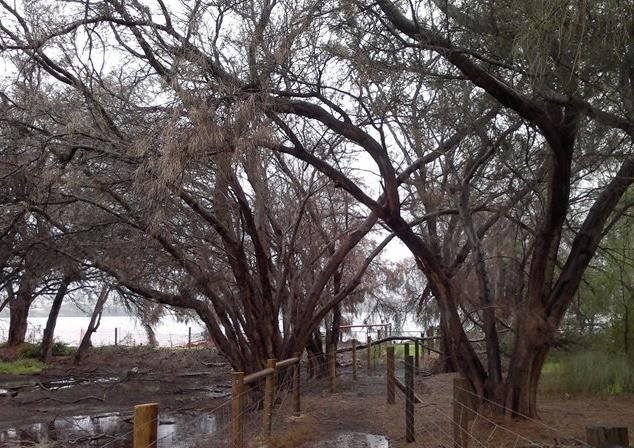
What is Dieback?
Phytophthora Dieback is an introduced water mould that lives in soil and plant tissue. It kills susceptible vegetation by causing root rot and stopping the transfer of water and nutrients up the stem of the plant.
Phytophthora Dieback can be found in suburban gardens, landscaped areas, golf courses, plant nurseries with poor hygiene practices, horticultural plantations and bushland.
More information on dieback can be found at the Dieback Working Group website.
Phytophthora Dieback spreads via the movement of spores through wet soil and from plant to plant through their root systems. Human activity in infested areas is the main method by which diseased soil is moved from place to place. It can also be spread by movement of infested gravel, road construction, animals and off-road vehicles. The risk of spread is greatest during spring and autumn.
The City of Melville is actively engaged in managing the impact and spread of dieback. Although there are effective treatments to slow the spread of Phytophthora Dieback, there is no known method to eradicate the pathogen.
Dieback in the City of Melville has been confirmed in the following locations:
- Wireless Hill Park
- Ken Hurst Park
- Blue Gum Lake
- Attadale Quarantine Area
- Len Shearer Reserve
- Beasley Reserve
- Ron Carrol Reserve
- Douglas Freeman Park
- Bill Brown Reserve
- Peter Ellis Park
- Robert Weir Park
- Richard Lewis Reserve
- Piney Lakes Reserve
- Harry Sandon Park
- Point Walter
- Harry Stickland
- Peter Bosci Reserve
- Bull Creek Reserve/Brockman Park
- Phillip Jane Reserve
- George Welby Park
- Al Richardson
- PJ Hanley Park
- William Hall Park
Phosphite Treatment
In the City of Melville, native vegetation is treated using phosphite; a biodegradable, non-toxic fungicide, that boosts a plants defence and enables it to survive being infected by Phytophthora pathogens. However, phosphite does not eradicate the disease, it only suppresses the symptoms.
Other Control Measures
The City of Melville has implemented a number of dieback control initiatives in bushland areas where dieback is present. Our initiatives include:
- Installation of boot cleaning stations at Wireless Hill Reserve, Attadale Reserve and Piney Lakes Reserve.
- Making dieback hygiene kits available for community group use in susceptible areas
- Providing dieback hygiene kits to Environmental Services department staff who work in our bushlands
- Mapping and treatment of our bushland reserves on a three yearly cycle to monitor the occurrence and spread of the disease
- Signage to mark out dieback infected areas
- Fencing to restrict access where there is high risk of dieback being spread
- Development of hygiene guidelines applicable to staff, contractors and the community who work in bushland areas.
There are a number of things you can do to help stop the spread of dieback:
- Adhering to signage, staying on paths and respecting fences in bushland areas
- Asking for dieback-free plants, gravel, potting mix, mulch and soil at your local nursery or garden centre
- Community members can get involved in protecting their local bushland areas.