Preparing for an emergency
Bushfire safety and preparing your property
Being ready for an emergency is crucial for protecting lives, reducing property damage, and ensuring community resilience during unexpected disasters. Regardless of where you live, having an emergency plan is essential. This ensures your family knows how to act quickly and safely during crises, such as bushfires, floods, or storms. When everyone is prepared, it strengthens the overall safety of the community, ensuring that resources can be allocated where they are needed most.
Bushfires can start anywhere at any time. Creating a bushfire plan is one of the most critical and valuable things you can do, and you can complete it in just 15 minutes. What will you do to stay safe when a bushfire threatens your home and family? Take the time now to make a few key decisions:
- When will you leave?
- What will you take?
- Where will you go?
Use the Emergency WA tool to create an emergency plan.
Translated resources
Please find information about how you can keep you and your household safe from disasters in your language.
Emergency warning information
Download the Emergency WA app from the Apple or Google store to receive instant notifications for warnings, incidents and other alerts.
What are Fire Danger Ratings?
Fire Danger Ratings are important because they provide people with information so they can take action to protect themselves and others from the potentially dangerous impacts of bushfires. Ratings are calculated using a combination of weather forecasting and information about vegetation that could fuel a fire. They do not indicate the chance of a fire occurring, although this is a common misconception. You can find the daily fire danger ratings for your property by visiting Emergency WA .
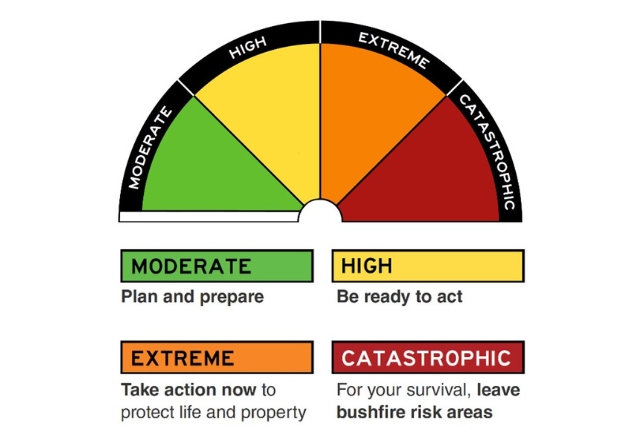
The fire danger rating levels are:
- Moderate (green): Plan and prepare
- High (yellow): Prepare to act
- Extreme (orange): Take action now to protect your life and property
- Catastrophic (red): For your survival, leave bush fire risk areas
The white bar under Moderate indicates No Rating for days where no proactive action is required by a community. This does not mean that fires cannot happen, but that any fires that start are not likely to move or act in a way that threatens the safety of the community. A video explaining the Australian Fire Danger Ratings can be found at Australian Fire Danger Ratings
More information about the ratings is available at Australian Fire Danger Rating System
During an emergency
Australian Warning System
The Australian Warning System is a national approach to information and Calls to Actions for hazards like bushfire, flood, storm, cyclone, extreme heat and severe weather.
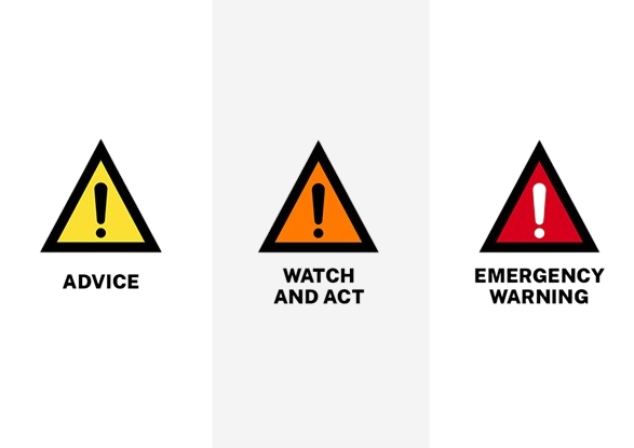
There are three warning levels:
- Advice (Yellow): An incident has started. There is no immediate danger. Stay up to date in case the situation changes.
- Watch and Act (Orange): There is a heightened level of threat. Conditions are changing and you need to start taking action now to protect you and your family.
- Emergency Warning (Red): An Emergency Warning is the highest level of warning. You may be in danger and need to take action immediately. Any delay now puts your life at risk.
For more information, plus a video explaining the Australian Warning System, please visit the Australian Warning System website.
Don't wait on a warning to act
It is important that you do not rely solely on receiving an official message and should always be aware of what is happening around you, as you could find yourself suddenly in danger. Act decisively the moment you know there is danger.
Emergency contacts
Knowing the right number to call for help in emergencies:
- All life-threatening emergencies (Police, Fire, Ambulance) call 000
- EmergencyWA
- Find information about fires, floods, storms, earthquakes, tsunamis, hazardous material incidents and traffic crashes.
- Website: https://www.emergency.wa.gov.au/ or Emergency WA app.
- Department of Fire & Emergency Services
- Emergency Information Line: 13 33 37
- DFES Alerts and Warnings: 1300 657 209
- Total Fire Ban Information Line: 1800 709 355
- Website: www.dfes.wa.gov.au
- Local Police assistance
- Non-Life Threatening/Non Emergency Phone: 131 444
- Website: www.police.wa.gov.au
- SES Emergency assistance
- For assistance with significant structural damage like collapsed roofs or ceilings, temporary emergency repairs to homes and buildings, removing fallen trees that have damaged homes and cars, sandbagging areas in danger of flooding, pumping out flood water.
- Phone: 132 500
- For details on the National Relay Service for hearing or speech impared assistance please visit https://www.accesshub.gov.au/about-the-nrs/how-to-make-an-emergency-call-using-the-nrs
- Information and alerts:
- ABC News - Local Radio: ABC 720 (and in larger emergency situations ABC 24 TV). Alerts and warnings from official sources are also published on ABC Emergency’s website
- Water Corporation - 13 13 75
- Western Power Emergencies - 13 13 51
- Gas Leak - 13 13 52
- Dial before you Dig - 1100
- Crime Stoppers - 1800 333 000 Bureau of Meteorology - 1300 659 210. Provides access to weather forecasts, severe weather warnings, weather monitoring and advice.
Evacuation centres are determined by the Department of Communities. They are generally located a safe distance from the emergency. Once determined, you will be informed of the location via ABC 720AM radio.
Please do not bring your pets to evacuation centres. We have an agreement with other Councils and Vets for housing pets during emergencies. Call MelSafe on 131 247 for further information during an emergency.
After an emergency
You can access financial support through the Lord Mayors Distress Relief Fund, the Department of Social Services and the Premier's Natural Disaster Recovery Fund, if applicable.If your home has been damaged as a result of a storm, please contact the State Emergency Service (SES) on 132 500.
Melville State Emergency Service (SES)
When a natural disaster strikes, such as storm, earthquake, or flood, State Emergency Service (SES) volunteers can be found assisting the local community and helping people get back on their feet. SES volunteers offer a variety of services to assist with the aftermath of natural disasters. These services include emergency building repairs, search and rescue in urban and other environments and ground support responding to natural disasters.
If you are interested in learning more and getting involved in any of these activities, contact the Melville SES Unit via email to enquiries@melvilleses.org.au.
SES volunteer training includes:
- First aid
- Map reading and navigation
- Land search techniques
- Storm damage techniques
- General rescue
- Radio communications
Emergency Management Arrangements
Local Emergency Management Arrangements
Please read our Combined Local Emergency Management Arrangement & Local Recovery Plan to ensure you are prepared in the event of an emergency. These arrangements are in place to manage the adverse effects of a natural disaster on a community.